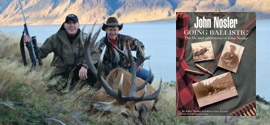


If you hunt mule deer, blacktails, Columbia whitetails, Rocky Mountain elk, Roosevelt elk, Sitka blacktail deer, Coues whitetails, axis deer (Hawaii and Texas) or black bear in the West, take a look at the books from Gary Lewis Outdoors. Hunting Oregon examines all Oregon hunting from the Steens Mountains to the Columbia River, from the Coast Range to the Snake River. Deer Hunting examines all western deer hunting. If you fish for steelhead and salmon in Oregon and Washington, or pursue Columbia River sturgeon, and walleye or chase largemouth and smallmouth bass, you’ll want to pick up Freshwater Fishing Oregon & Washington or Fishing Central Oregon and Beyond. Read the story of the world’s most influential bullet designer, John Nosler Going Ballistic. Gary Lewis Outdoors is also proud to announce several new books: Black Bear Hunting, the Complete Guide to Hunting and Trout Fishing the Pacific Northwest. Check out Fishing Central Oregon – the DVD and Fly Fishing Central Oregon – the DVD Volume II for a firsthand look at local waters.
|

Tactics
and strategies for the stream and the field
Reading Water
Look for a bubble line that drifts with the current. This is where careless caddis and unfortunate ants collect and where the larger trout line up to eat. Before you make the first cast, determine the best spot for a trout to wait.
Two Ways to Improve Trout Fishing Success –
1. Bring a water thermometer. Trout can survive within a wide range of water temperatures, but they become more active when the temperature rises above 40 degrees. Treat the fishing day like you would a scientific experiment.
2. Keep a journal to record what worked and what to bring next time. Refer to your journal before each return visit. Over the seasons your catch rates are likely to increase.
Optics for the Bear Hunter
The single best thing (besides a rifle) you can bring on a spot-and-stalk bear hunt is a binocular. And put it on a shoulder harness. A neck strap isn’t good enough. You want the binos to ride suspended from your shoulders rather than hang like a noose around the neck. Your chiropractor would agree.
You’ve scouted, you know you’re in good habitat. Sit down and glass. Put the binos to use. The longer you stay in one place, the higher the odds that a bear will show.
|
|

Bass – Top water lures work best at morning and evening, when bass are more oriented toward the surface. Sometimes bass will strike at your top-water lures, but sometimes you can't get a hookup.
Keep a second rod rigged with a plastic worm or jig close to hand. When a bass misses the top-water lure, drop that rod and cast immediately to the same spot with the soft plastic rig. Often the bass will grab the ‘safer’ subsurface lure with reckless abandon.
Calling Coyotes – It doesn’t take a lot of experience to call in a coyote, but it does take a coyote in earshot. Go where the food is. Hunt near sheep and cattle ranches during lambing and calving operations. In the winter, follow deer, antelope and elk herds.
Pick a spot in front of a bush or a tree to break up your outline. Post a partner to watch in another direction. Often, a coyote circles to catch the scent before charging in. Wear camouflage and a facemask. It’s important to conceal the shine of your face. But don’t let the facemask break up your peripheral vision – you’re going to need it.
Fly Fishing Central Oregon – The DVD Volume II – Look for Gary’s latest project on this site and at http://www.amazon.com/Fly-Fishing-Central-Oregon-Beyond/dp/1882084187/ref=sr_1_2?ie=UTF8&s=dvd&qid=1242078310&sr=8-2
Seminars / Booksignings
To meet Gary Lewis in person at an upcoming seminar or book-signing, click on Contact Info for a schedule of events. |